Nu skal historien bringes til overfladen


Memorial park for the Battle of Jutland
The Memorial Park for the Battle of Jutland is located in the dunes west of the town of Thyborøn, right by the North Sea. In a unique land art installation, a monument has been erected in honor of the 8,645 German and British sailors who perished during a naval battle still considered the largest in the world: the Battle of Jutland.
The naval battle, which stretched along the entire west coast of Jutland from Hanstholm to Blåvandshuk, took place on May 31 and June 1, 1916. On the British side, 149 ships with approximately 52,500 men were involved, while the German side had 101 ships with around 37,500 men on board.
Nu skal historien bringes til overfladen

Nu skal historien bringes til overfladen
The two fleets – the British Grand Fleet under Admiral John Jellicoe and the German High Seas Fleet under Admiral Reinhard Scheer – made contact on the afternoon of Wednesday, May 31, 1916. This was triggered by the Danish merchant ship N.J. Fjord, which was spotted by the German cruiser Elbing. N.J. Fjord had to come to a stop, releasing a white plume of steam that was seen by the British cruiser Galatea.
The fleets met, and while N.J. Fjord managed to build up steam and escape unharmed, the shooting began. It was so intense that the thunder of the cannons could be heard deep into Jutland. After about 12 hours of battle, 25 vessels had been sunk and 8,645 sailors had lost their lives.
The battle ebbed and flowed, but gradually moved southward toward German waters, and in the end, the German fleet was fully withdrawn. Who won the battle? The British suffered the greatest losses in ships and men, but the German fleet never again dared to venture into the North Sea.
Britain imposed a blockade on the supply of raw materials and food to Germany. As Germany failed to secure a quick victory on land, this blockade ultimately decided the outcome of the war. Germany tried several times to break the blockade and retaliated with unrestricted submarine warfare, but in vain. Britain maintained naval dominance and thus won the war.
Nu skal historien bringes til overfladen
Nu skal historien bringes til overfladen
The memorial park
The Memorial Park for the Battle of Jutland does not distinguish between the British and German navies in its design. The core idea behind the project was to create a shared remembrance on neutral ground, near the waters where the battle took place.
The park was inaugurated on June 1, 2016, on the 100th anniversary of the Battle of Jutland.
The Memorial Park is a unique work of art on a monumental scale. Twenty-five granite stones of varying heights – up to 3.5 meters – have been erected, one for each of the sunken warships. They are positioned in relation to each other as the wrecks lie on the seabed today. Each stone bears the name of the sunken ship and the number of sailors who died when it went down. Around the stones stand 1-meter-high concrete figures, representing the sailors who perished on that specific ship.
The work was created by artist and sculptor Paul M. Cederdorff. At the park’s opening, he explained “why the Memorial Park in Thyborøn looks the way it does”:
“The Memorial Park should be perceived as a living organism, at the mercy of nature and in constant transformation. The stones and figures will change color over time in response to the weather. They will be exposed to sun, wind, rain, and drifting sand. Sandblasted and ever-changing, they will reflect light and blend into the stark and dramatic landscape, creating a connection between nature and history.
The stones were originally shaped by the violent geological forces of the Earth. Removed from the mountain’s maternal, eternal calm through human effort, they bear the marks of both nature’s power and human intervention. Through their raw geological expression and the visible traces of human shaping, each stone tells the dramatic story of the shattered and sunken warships it symbolizes—where 8,645 German and British sailors perished in a naval battle on the North Sea in the spring of 1916.
The figures stand in minimalist simplicity—the movement of lines, the shaping of the material by light into a recognizable human form. The slightest change in light gives the impression of a person, blurred by the passage of time, yet evoking a sense of presence that makes the experience feel immediate and contemporary.”
— Paul Cederdorff,
May 31, 2016
Nu skal historien bringes til overfladen
Nu skal historien bringes til overfladen
The monuments
25 granite stones of varying heights – up to 3.5 meters – are placed throughout the park. One stone for each of the sunken warships is positioned according to where the wrecks lie on the seabed today.
Click the drawing below to learn more about each monument.
Nu skal historien bringes til overfladen
Nu skal historien bringes til overfladen
Sea War Museum
Behind the Memorial Park for the Battle of Jutland stands the man also behind the Sea War Museum – diver and businessman Gert Normann Andersen from Holstebro. Over the years, he has recovered thousands of items from the seabed related to the battle and has “mapped” the battlefield so precisely that the exact locations of all 25 sunken ships are now known.
Some of the recovered items were exhibited at the Strandingsmuseum in Thorsminde, while others were stored at his company, JD-Contractor A/S in Holstebro. Around 2012, he decided that the public should have access to the collection. When Thyborøn made some of the so-called “Red Houses” available to him, he established what is now the Sea War Museum on the edge of the sea in Thyborøn.
The purpose of this unique museum is to research and raise awareness of the naval war in the North Sea during World War I. It tells a number of dramatic stories from the Battle of Jutland, brought to life by original artifacts from the event. In connection with the museum, a marine archaeological center will be established, including a maritime archive and a research library, available to both professionals and amateurs.
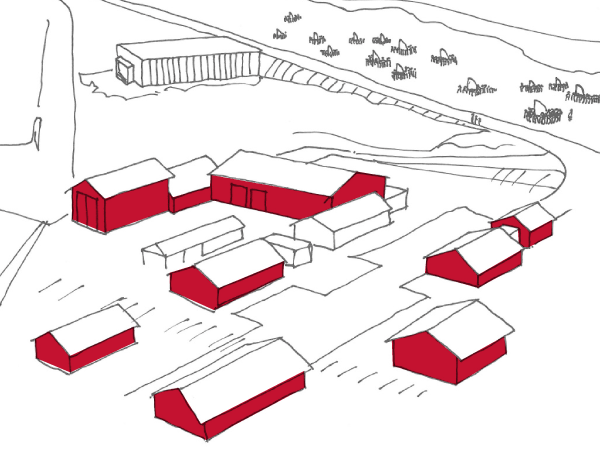
Sea War Museum Jutland im Vordergrund, mit dem Gedenkpark und der Nordsee im Hintergrund.
